
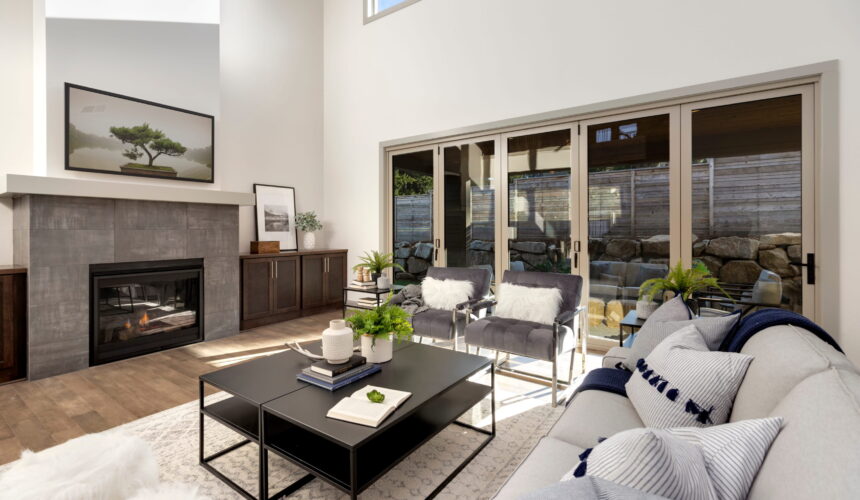
You've invested in low-VOC finishes, premium filtration, and a tight building envelope. But if your ventilation system is undersized, poorly balanced, or never verified, you're breathing stale, contaminated air every day without knowing it.
Healthier custom homes require more than just upgraded materials. In Camas and the broader Portland metro, where we're building tighter envelopes for energy performance, mechanical ventilation isn't optional anymore. It's the only way fresh air reliably enters your home. Yet most builders treat it as an afterthought, spec the cheapest unit that satisfies code minimum, and never test whether it actually works. The result? Elevated CO₂ levels, lingering VOCs from furniture and cleaning products, excess humidity that feeds mold growth, and indoor air that's often 2-5 times more polluted than outdoor air. Here's how to make sure your home ventilation system actually protects your family instead of failing silently behind the drywall.
Why Home Ventilation Mistakes Cost You More Than Comfort
Ventilation errors don't announce themselves with a leak or a broken hinge. They accumulate quietly. You might notice stuffiness in the morning, condensation on windows in winter, or lingering cooking odors. Most homeowners assume it's normal. It's not.
When ventilation fails in a high-performance home, you're essentially living in a sealed box. Every breath you take depletes oxygen and adds CO₂. Every shower adds moisture. Every piece of particle-board furniture off-gasses formaldehyde. Without adequate air exchange, those contaminants concentrate. The EPA indoor air quality research shows indoor pollutant levels can reach 2-5 times outdoor levels, even in rural areas like Camas.
The health impacts are real. Chronic exposure to elevated CO₂ impairs cognitive function. Excess humidity enables mold colonization in wall cavities you'll never see until it's a significant remediation job. VOCs from finishes, adhesives, and furnishings trigger respiratory irritation and allergic responses. And if you have young children or family members with asthma, poor indoor air quality isn't just uncomfortable. It's a daily stressor on developing lungs.
The Cost of Fixing Ventilation After the Fact
Retrofitting ventilation in a finished home means opening walls, running new ductwork through conditioned space, and coordinating with electrical and HVAC trades all over again. Costs hit substantially higher levels, and you'll live in construction chaos for weeks. Compare that to designing it correctly from the start, when the walls are open and coordination is straightforward.
Why Code Minimum Isn't Enough
Building codes set a floor, not a ceiling. The minimum ventilation rate in ASHRAE 62.2 assumes average occupancy, average pollutant loads, and average air leakage. If you're cooking daily on a gas range, hosting guests regularly, or running a home office, your ventilation needs exceed the baseline. We model ventilation loads during the design phase and size systems for real-world use, not code minimums.
Mistake #1: Undersizing Your ERV or HRV System
Most builders pick an energy recovery ventilator (ERV) or heat recovery ventilator (HRV) based on square footage alone. They'll grab a unit rated for homes up to 2,500 square feet and call it done. That approach ignores occupancy, bedroom count, and the actual air exchange rate your home needs.
ASHRAE 62.2 calculates required ventilation based on floor area and number of bedrooms. A 2,400-square-foot home with four bedrooms needs significantly more continuous airflow than a 2,400-square-foot home with two bedrooms, because more people generate more CO₂, moisture, and pollutants. If your system can't deliver the calculated CFM (cubic feet per minute), it's undersized from day one.
How to Size Ventilation Correctly
We run a room-by-room ventilation load calculation during technical plan review. It accounts for home volume, occupancy, kitchen and bath exhaust requirements, and the desired air changes per hour. Then we spec an ERV or HRV that can meet that load even when filters are partially loaded and the system is running at typical speed settings, not just wide-open max.
ERV vs HRV: Which One Fits Camas Climate?
Camas sits in a mixed-humidity climate. Summers are dry; winters are wet. An ERV transfers both heat and moisture between incoming and outgoing air streams, which helps moderate indoor humidity year-round. An HRV transfers only heat. For our climate, ERVs generally perform better because they prevent your home from becoming too dry in winter (when you're heating) and help manage moisture in summer (when you're cooling). If you're building in the Portland metro, default to an ERV unless your HVAC engineer has a specific reason to recommend otherwise.
Mistake #2: Poor Supply and Exhaust Duct Placement
You can have a perfectly sized ERV and still end up with stale air if the ductwork is routed incorrectly. Ventilation is about distribution, not just volume. Fresh air needs to reach occupied spaces. Stale air needs to be pulled from the most polluted areas.
We see builders dump fresh air supply into a central hallway and pull exhaust from a single bathroom. The result is short-circuiting. Fresh air takes the path of least resistance straight to the exhaust pickup without ever reaching bedrooms, the living room, or the home office. Meanwhile, the primary bathroom and kitchen, where moisture and pollutants concentrate, never get adequate exhaust.
Best Practices for Duct Layout
Supply fresh air to bedrooms and primary living areas where people spend the most time. Exhaust from bathrooms, laundry rooms, and kitchens where moisture and contaminants originate. Avoid placing supply and exhaust registers in the same room unless the space is large enough to prevent short-circuiting. In our homes, we run dedicated supply ducts to each bedroom and primary living zone, and we pull exhaust from every bathroom and the kitchen. It costs more in duct material and labor, but it ensures every room gets fresh air, not just the hallway.
Avoiding Duct Leakage and Heat Loss
Ducts that run through unconditioned attics or crawlspaces lose energy and can condensate in winter. We route ventilation ducts inside the building envelope whenever possible and seal every seam with mastic (never just tape). After installation, we test duct leakage with a duct blaster to verify the system is tight. Leaky ducts can lose 20-30% of airflow before it even reaches the register, effectively undersizing your system and wasting the energy you spent recovering heat.
Mistake #3: Ignoring Makeup Air for Range Hoods
High-CFM range hoods are standard in modern kitchens. A 600-CFM or 900-CFM hood does a great job clearing smoke and grease, but it also creates a powerful negative pressure when it runs. In a tight home, that negative pressure has to be relieved somehow. If you haven't provided makeup air, the house will pull air from wherever it can: down the chimney (if you have one), through the water heater flue, or by sucking air backwards through bathroom exhaust fans.
This is called backdrafting, and it's dangerous. Combustion appliances can spill carbon monoxide into living spaces. Sewer gases can be pulled up through drain traps. The pressure imbalance also makes doors hard to open and can cause the range hood itself to underperform.
When Makeup Air Is Required
Most codes now require dedicated makeup air if your range hood is rated above 400 CFM. Even if your hood is below that threshold, we recommend makeup air if you're building a tight, high-performance home. The tighter the envelope, the more pronounced the pressure imbalance.
How We Integrate Makeup Air
We install a dedicated makeup air system that's interlocked with the range hood. When the hood turns on, the makeup air damper opens automatically, pulling in fresh outdoor air to balance the exhaust. That air can be tempered (slightly warmed in winter) to avoid a blast of cold air into the kitchen, or it can be delivered as-is if the kitchen has enough heating capacity to handle the load. Either way, your home stays balanced, your range hood works as designed, and you're not backdrafting combustion gases.
Mistake #4: Skipping Radon Mitigation in New Construction
Radon is a radioactive gas that seeps into homes from soil. It's the second leading cause of lung cancer in the United States, and the resources page on radon testing explains why it's especially relevant in the Pacific Northwest. Parts of Camas and the greater Portland metro have moderate to elevated radon potential, yet most builders don't install passive radon mitigation unless the homeowner specifically asks.
Passive radon systems are inexpensive to install during construction in materials and labor because the pipe can be routed through the framing before drywall. Retrofitting a radon system after move-in costs significantly more and requires drilling through finished floors or exterior walls.
What a Passive Radon System Includes
A passive system consists of a 3-inch or 4-inch PVC pipe that runs from beneath the slab (or crawlspace membrane) up through the conditioned envelope and terminates above the roofline. It relies on natural air currents and the stack effect to vent radon outdoors. If post-occupancy testing shows radon levels above the EPA action level, you can convert the passive system to active by adding an inline fan. The hard part (the pipe and routing) is already done.
Testing and Verification
We install passive radon rough-in on every home we build, regardless of projected radon levels. After move-in, we recommend a 48-hour radon test using a calibrated monitor. If levels are elevated, we activate the system with a fan. If levels are low, you have peace of mind and a failsafe in place if soil conditions change over time.
Mistake #5: No Third-Party Verification or Commissioning
The most common ventilation mistake isn't a design error or a missed component. It's assuming the system works without ever testing it. Builders install the ERV, run the ducts, and move on. Nobody measures airflow at the registers. Nobody verifies the system is balanced. Nobody checks whether the controls are programmed correctly.
Without commissioning, you have no idea if your ventilation system delivers the air it's supposed to. We've walked into brand-new homes where the ERV was installed but never wired to power. Homes where the unit was set to the lowest speed and never explained to the homeowner. Homes where return ducts were kinked during framing and airflow was cut in half.
What Third-Party Commissioning Includes
Commissioning is the process of verifying that installed systems perform according to design intent. For ventilation, that means measuring supply and exhaust airflow at every register, checking the ERV heat recovery efficiency, confirming controls are wired and programmed correctly, and documenting the results in a commissioning report.
We bring in an independent third-party verifier (usually an HERS rater or building performance consultant) to test every home before the final walkthrough. They use a flow hood to measure CFM at each register, a blower door to test envelope tightness, and a duct blaster to test duct leakage. If something's wrong, we fix it before you take possession. That's the difference between a home that's certified healthy and one that just claims to be.
Why Builder Self-Certification Isn't Enough
Some builders will tell you they "verify" systems in-house. That's not the same as independent third-party verification. When the same team that installed the system is also the one testing it, there's an inherent conflict of interest. Third-party verification removes that bias and gives you documented proof that your home performs as promised. It's also required for certifications like DOE Zero Energy Ready and NGBS Green, both of which we pursue on our healthier custom homes.
How Marnella Homes Designs Ventilation for Long-Term Health
We've been building high-performance homes since 2005, and we learned early that a tight envelope without proper ventilation is worse than a leaky one. Ventilation is part of our technical plan review process, which happens before we break ground. Our design team models ventilation loads, specs equipment, and routes ductwork to ensure balanced distribution. Then we verify it works with third-party commissioning before you move in.
Every Marnella home includes an ERV or HRV sized for actual occupancy, supply ducts to every bedroom and living area, exhaust from all bathrooms and the kitchen, makeup air for range hoods above 400 CFM, passive radon rough-in, and post-construction airflow verification. It's not an upgrade package. It's standard, because we build healthier custom homes, not just code-minimum boxes.
If you're planning a custom home or major remodel in Camas, Lake Oswego, Milwaukie, or anywhere in the Portland metro, ventilation design needs to happen during the planning phase, not as an afterthought during framing. We've seen too many projects where the HVAC contractor shows up late in the process and tries to retrofit a ventilation strategy into a design that was never built for it. By then, your options are limited and your costs are higher.
Frequently Asked Questions
What's the difference between an ERV and an HRV for Camas homes?
An ERV (energy recovery ventilator) transfers both heat and moisture between incoming and outgoing air. An HRV (heat recovery ventilator) transfers only heat. In Camas' mixed-humidity climate, ERVs generally perform better because they moderate indoor humidity year-round without over-drying in winter or adding excess moisture in summer.
How often should I run my home's ventilation system?
Continuously. Modern ERVs and HRVs are designed to run 24/7 at low speed, providing steady fresh air exchange. Running intermittently causes indoor air quality to swing between acceptable and poor. Most units draw less power than a standard light bulb when operating at continuous low speed.
Can I use bathroom exhaust fans instead of a whole-home ventilation system?
Bathroom fans are spot ventilation. They remove moisture during showers but don't provide continuous fresh air to bedrooms and living areas. In a tight home, you need both: whole-home ventilation for baseline air exchange and spot exhaust for moisture and odor control. One doesn't replace the other.
Do I need makeup air if my range hood is under 400 CFM?
It depends on how tight your home is. If you're building to Passive House or net-zero standards, even a 300-CFM hood can create noticeable pressure imbalances. We recommend makeup air for any hood above 300 CFM in high-performance homes, regardless of code minimums. The cost is minimal during construction and prevents backdrafting risk.
Your home's ventilation system is invisible, silent, and easy to ignore. But it's also the primary determinant of indoor air quality and long-term health. Don't let poor design, undersized equipment, or missing verification turn your healthier custom home into a liability. If you're ready to build a home in Camas or the Portland metro that actually protects your family's health with verified performance, schedule a healthy home assessment with Marnella Homes. We'll walk you through our technical plan review process and show you exactly how we design, install, and verify ventilation systems that work for decades, not just on paper.
